Do you wish you were more relaxed over the golf ball? Or, wish that you had more confidence before you hit your next shot?
If so, we have a golf tip that could help change everything.
So what is it? A golf waggle.
But this move is often misunderstood by a lot of amateur golfers and they don’t get the most out of it. In this article, we look to break down common misconceptions of the waggle and see how it can have a massive impact on your golf swing.
So, what is a waggle in golf?
The great Ben Hogan referred to it as “the bridge.” As he said in his book, Five Lessons, “The bridge between the address and the actual start of the backswing is the waggle.”
Fast forward decades later, and golfers still use this tip to become more confident over the ball.
But is there a right way to waggle? A wrong way? Do you even need to have a waggle?
We answer all these questions about waggling the club and more in this article.
Golf Waggle 101
First off, the pre swing waggle is not a fidgety move that is done without a purpose (in general). No, it’s a specific move that golfers make for a few reasons with intention, it’s not a random move because they are nervous.
Unfortunately, the waggle has got some bad press in the past because of routines like Sergio Garcia. Notably, his “waggles” or “regrips” at the same 2000 US Open at Bethpage Black. You don’t need to be a golf instructor to know that he stood over the golf ball forever and the fans got impatient.
The New York fans heckled him, making a wildly difficult golf course even more challenging. Not to mention, he was competing against Tiger Woods in his prime and trying to win his first major title. Needless to say, it wasn’t well received and a lot of golf fans won’t let him forget about it anytime soon.
But the pre swing move is super helpful when used correctly. There are a lot of reasons why so many players prefer a waggle, so let’s review why it’s an extremely important part of your pre-shot routine.

Releases Tension
The first reason you should start wagging asap is that it helps reduce tension in your body. Specifically, excess tension in your hands and arms, which help keep the rest of the body loose. This will help you avoid too much grip pressure and ensure you’re relaxed at address position.
Not only will it release tension in your arms, but it should also travel to the rest of your body as well. As Hogan said, “The trunk of the body and the shoulders pick up this beat, smoothly from the arms and the legs. The whole body, in effect, becomes synchronized to the rhythm in which the various parts will be working cohesively together during the swing.”
Primes Your Backswing
The second reason a waggle is beneficial is that it prepares your mind and body for the shot you’re about to hit. Hogan referred to it as a mini-backswing or a dry run for the upcoming shot.
Here’s what he said about it in his book, “As the golfer takes the club back on the waggle, he accustomed himself to help at the club and will be taking on his actual backswing. As he waggles the club forward, he adjusts himself so that the face of the clubhead will be coming into the ball square and on the line.”
The waggle is basically a runway to the backswing. It should really blend into the swing so that your takeaway is an extension of your waggle.
Provides a Mental Picture to Your Brain
While it primes your backswing, it also primes your mind for success as well.
The waggle precedes the shot and attempts to paint a mental picture for your brain to get your muscles ready to hit the shot. Essentially, it’s giving you time to visualize the shot in your mind’s eye so you can communicate what you want to do from a static position.
Visualization is one of the most important parts of golf and really all sports. As Psychology Today found, “Brain studies now reveal that thoughts produce the same mental instructions as actions. Mental imagery impacts many cognitive processes in the brain: motor control, attention, perception, planning, and memory. So the brain is getting trained for actual performance during visualization.”
Who knew an innocent few waggles could do so much for the mental side of your game as well?
Narrows Your Focus on the Golf Shot
Finally, the waggle helps you narrow in on the shot you’re about to play. Specifically, it helps you focus your conscious mind on the shot and only the shot.
Because here’s the thing, so many of us read, watch, and listen to golf swing tips that we sometimes get in our heads too much. But a cluttered mind full of swing thoughts when you’re over the golf ball is pretty much a recipe for disaster – just ask any golf instructor.
To hit great golf shots, you need to be thinking about the shot – not swing mechanics.

How to Waggle The Club Head Before Golf Shots
While there are some epic waggles on the PGA Tour, one of the best examples is Tom Watson. This YouTube video shows that his waggle has been consistent his entire golfing career, which goes to show how important it is to his routine.
You can see in the video that he has two simple waggles right before he pulls the trigger on his swing. It helps him stay loose, focus on the target (not mechanical swing thoughts), and initiate the club head for the backswing.
But there is an art to the waggle so that it’s an effective part of your pre-shot routine. Here are some guidelines to help you maximize this simple golf tip.
Hands Only
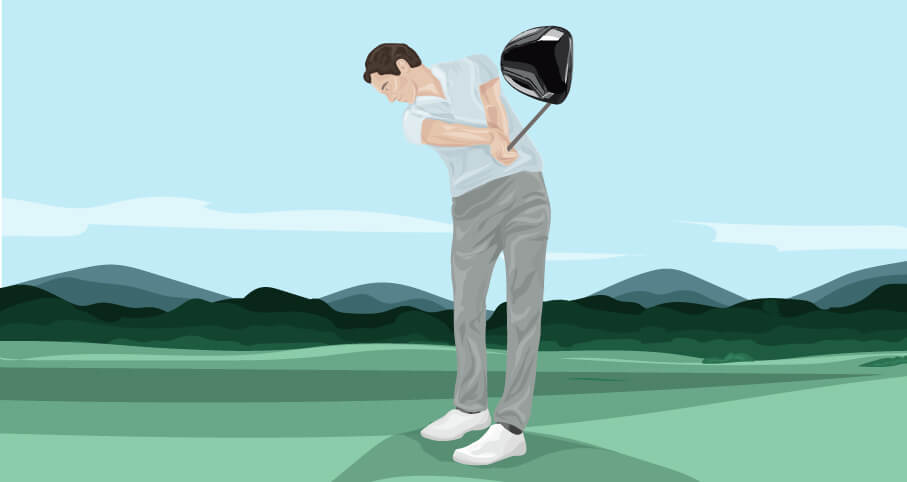
One of the most important things to remember, if not the most important, is that the waggle is hands only – not shoulders. While it is a miniature swing, it’s only done with the hands to feel the shot, not the rest of your upper body.
Specifically, it’s done with your left hand (if you’re a right handed golfer) as it’s the dominant hand of the grip. While you waggle, the right elbow should hit the font part of your right hip. But the upper part of your arms remain in place, close to your chest before you go away from the ball.
Feet and Grip
Another part of the waggle that isn’t talked about as much is the grip and the feet. A lot of players prefer to keep moving their feet to get into the shot as well. Some players also like to adjust their grips to get it into the exact spot to load up and relax before swinging.
This is more personal preference than anything. I’m someone that likes to adjust my feet and move them around in my shoes as I’m getting ready to hit a shot. This keeps me loose and my body moving before pulling the trigger.
The goal here is to make sure every movement is intentional and keeps you relaxed before the shot. The last thing you want is your waggle. It makes you nervous because you’re standing over the ball thinking about the shot or mechanics. Instead, it should free up your mind and body for success.
Tempo Your Waggle For the Shot
The third part of a good waggle is to cater it to the specific shot you’re about to hit.
Remember, this is a miniature backswing that is priming all parts of your body for success. You want your waggle to represent the shot you’re about to face, just like you do with a full practice swing. Whether it’s a short game one or swinging hard.
For example, if you need to rip a drive so you can get home in two, your practice swings should be full and aggressive. You want to let your mind know that this isn’t some lackadaisical swing, it’s one that is going to be all about power.
The same goes for your waggle once you’re over the ball. You want to give your mind one final confirmation for the shot you’re about to hit.
Perhaps the best example of this is Bryson DeChambeau. When he’s about to unleash his speed on the ball, his waggles are extremely aggressive.
On TV, you can see he’s getting his lower body moving, confirming the target, and getting ready to swing as hard as possible. Needless to say, it’s a very different tempo than he uses for irons or short shots around the green.
Always make sure to cater both your practice swing and your waggle for the specific shot you’re facing.
Set a Number of Waggles
Also, you want to have a set number of waggles before finally pulling the trigger. If you watched the Tom Watson video from above, you know what I mean. As he gets into the shot, he has a few waggles every single time and has for 30+ years.
Don’t be like Sergio Garcia at the 2000 US Open and take 5-10 waggles or regrips. This will drive your playing partners crazy and likely won’t have a positive effect on your game either.
Tiger Woods takes two waggles, some take three, and others only one. The point is, have the same amount before you take the club back to signal to your mind it’s “go time.” It will also make sure you don’t slow down the pace of play, either.
Practice on the Range and Short Game Area
Don’t just take this move straight to the golf course, either. Instead, spend time practicing it on the driving range so that it becomes part of your routine.
You want your pre-shot routine to become automatic so that you can get into the zone and quit thinking about your golf swing or nerves. The sooner you can make it an effortless part of your swing, the sooner you can reap the benefits of the waggle.
Reminder: Don’t Groove Your Waggle
Each waggle is unique to the shot you have at hand. Don’t make it robotic, instead, it should be a feel part of the game that is not mechanical at all.
As Ben Hogan said in his book, “The rhythm of the waggle varies with each shot you play. Don’t groove your waggle. It takes instinct to plan to play a golf shot and your preparations for each shot must be done instinctively.”
The waggle should fit your shot that you’re about to hit.
FAQs About Waggling and the Golf Swing
Do you have more questions about a waggle in your golf game? If so, we’ll cover them in the frequently asked questions and answers below.
Should you waggle in golf?
While everyone has different swings and routines, I would say that yes, you should have some sort of waggle. When done correctly, it can help you relax your muscles and mind before taking the club back and starting your backswing.
According to one of the best ball strikers in the world, Ben Hogan, it’s not only suggested but a huge part of shot making too. If you’re tight or struggling with nerves and need an idea to loosen up, these tips can help you big time.
Does Tiger Woods waggle the golf club?
Yes, the 15-time major champion does have a regular waggle routine with his full swing. As you can see in any YouTube clip, he has two simple waggles to help him get into the shot. He also adjusts his feet and grip to get comfortable over the ball.
Does the waggle change with different shots and clubs?
Yes, it should change based on the shot that you’re about to hit. Remember, almost no two shots are the same, so your waggle should be customized for the upcoming shot.
Which means your waggle will be very different for a 60 yard pitch shot vs. a drive where you need to carry it 250 yards to clear a water hazard.
Please note: the waggle fits the swing, don’t make it cookie-cutter!
Why do golfers shuffle their feet?
A lot of golfers shuffle their feet as part of their routine to get comfortable and keep their body moving. By shuffling around, it helps you get aligned to your target so you can make a solid swing.
But almost as important as shot alignment is staying loose and relaxed before starting your backswing. Small movements, like the waggle or feet movement, keep your body in motion and make it easier to take the club back to begin the backswing. It’s much easier than going from a fully stagnant position, as you already have some movement.
Why does Justin Thomas look at his club on his pre-shot routine?
Justin Thomas aka “JT” has a very recognizable routine. After setting up the golf ball, he looks at the target, then gets into his waggling routine.
So what is he looking at?
His initial takeaway position, specifically, two things.
First, he’s looking at the path to make sure it’s not too inside on the backswing. Second, he’s evaluating the club face itself to make sure it’s neutral and not open or closed.
If you struggle with taking the club too far to the inside on the backswing, this is a great waggling routine that I think a lot of people could benefit from. It’s a good reminder before taking your full swing to push the club out more instead of letting it get inside too early.
Because when this happens, it’s easy to have the club laid off at the top of the backswing and create an over the top downswing. This leads to the dreaded slice that so many golfers struggle with.
Avoid that with a more outside to inside takeaway and you’ll be set!
Final Thoughts on Waggling the Club
The waggle is a great way to stay loose and prime your backswing for success. Every golfer is different, but if you join the trend, I’m confident it will help you drop a shot or two from just feeling more confident.
Remember, the golf swing is a continuous movement with a goal to create the perfect sequence of events. It all starts with the hands taking the club away, then the arms, shoulders, and hips (and reverse on the downswing).
Also, make sure the waggle does not slow down the pace of play. It should be there to help your game, not get you into trouble with the marshal because you’re playing slow golf. Don’t be like Sergio in 2000!
Instead, use the waggle strategically to prime yourself for the shot, stay relaxed, and make a solid first move off the golf ball.