

A golf pre-shot routine is the one thing that all professional golfers have in common.
It’s not their equipment, takeaway, tempo, or any other part of their swing. It’s what they do before every single golf shot – whether they’re hitting driver, an iron, a difficult pitch or a short putt.
Instead, it’s a good pre shot routine. Each has their own unique version to help them prepare for different golf shots and execute at a high level.
So if you want to improve your game and start shooting lower scores, you need a pre-shot routine as well. In this post, we will cover exactly why you need a pre-shot routine, the mental benefits, and how to create one that builds confidence when you’re standing over the ball.
Key Takeaways
- A good golf pre-shot routine is the one habit all the best players – both pros and ams – have in common.
- Routines are key for non-reactionary sports like golf as they help players mentally and physically prepare. Other sports where players practice routines include NFL field goal kickers and basketball players at the free throw line.
- It’s important to create a routine at the practice range so it becomes automatic on the golf course.
- A good pre-shot routine is also crucial for short game and putting, not just full swing either.
Keep reading to learn how to improve your pre-shot routine so you can make your best swing on every shot.
Why You Need a Pre-Shot Routine
Success always leaves clues. In golf, that means acting like the pros even if you don’t bomb it 300+ yards or hit 9-irons 165 yards. But if you can add some of their secrets to your game, regardless of skill level over time your game will improve.
A pre-shot routine is something every professional golfer does that most amateurs simply skip. But a pre-shot routine has so many benefits including:
- Speed up play
- Calm your Nerves
- Overcome first tee jitters
- Shoot more consistent scores
- Gain more confidence with every shot
- Adjust to new golf courses and conditions
- Play better in competitive golf and under pressure
And so much more. Dr. Bob Rotella one of most well known golf sports psychologist said it best,
Your pre-shot routine is like your wingman on the course.
A pre-shot routine can literally act like a caddy for you if you put in the work and create one that benefits your game. Having your own pre shot routine is simple, easy, and one of the best ways to spend time on the driving range.
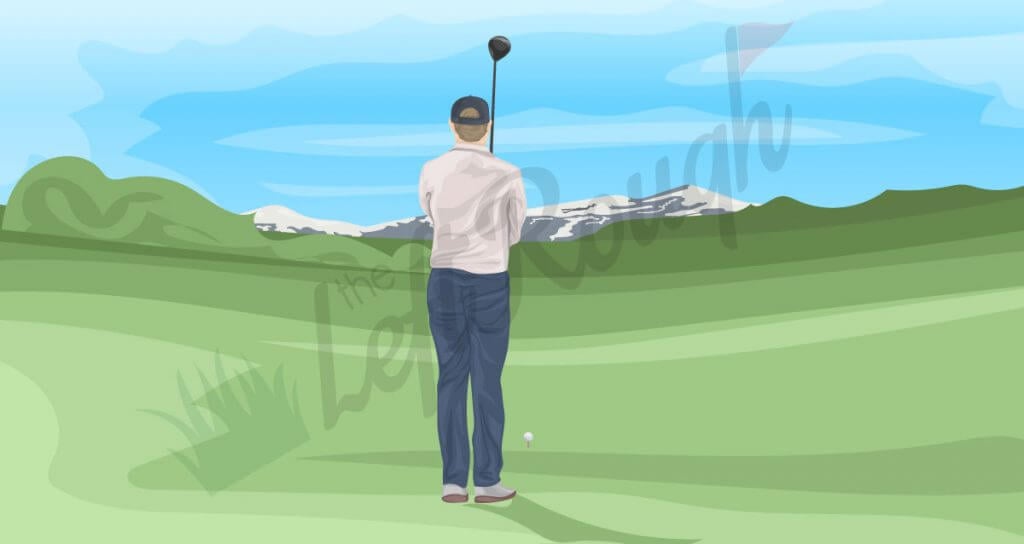
How to Start a Golf Pre-Shot Routine
Every great player has a pre-shot routine but sort of like putting, there is one specific way to do it. If you watch Tiger Woods has a different routine than Justin Thomas or Keegan Braddley. Each player has experimented with what works best for them.
You should do the same – experiment with different routines to see which one gives you the most confidence over the ball. Here are the most important things to consider when creating a golf pre shot routine for your full swing.
Have a Trigger
Most golfers don’t realize it but pre-shot routines start before you get to the golf ball. It should start on your way to the tee box, fairway or green, especially if you are walking.
Having some sort of trigger – like applying the velcro to your glove is a good way to lock in and start the process. This will signal to your mind that it’s time to focus and begin calculating your target, distance, and club selection.
Calculate Your Distance for Club Selection
Once you’ve velcroed in, it’s time to calculate your distance. If you’re on the tee box, create a tee-box strategy.
Ask yourself questions like:
- What is my target?
- How should I play this hole?
- What club will get me in the best spot ?
- Are there any fairway bunkers, OB or hazards to avoid? What is the best miss?
For fairway shots, you will want to build an approach shot strategy and ask yourself these types of questions.
- What is the distance to the flag? It’s also a good idea to consider the distance to the back of the green or front of green depending on the pin location.
- What is the best club to hit this shot? Trust your gut instinct as it’s right most of the time.
- Where is my target on the green? Is it the flag? A tree behind the green? Clarify to your mind the target so it has a clear goal.
- Where is the best place to miss? This way you can avoid getting short sided and hopefully get the ball up and down if you don’t hit the green in regulation.
- Are there any bunkers, OB or hazards to avoid? Noting trouble is one of the most important things with a routine but always focus more on where you want the golf ball to end up.
While this sounds like a lot to think about after enough practice it’ll become second nature. If you have any scratch golfers in your group, watch how they analyze for the next shot in a matter of seconds.
If you’re playing in a competitive event you might also consider using yardage books and pin sheets.
Pick a Target
Once you’ve done the research for the upcoming golf shot and committed to the intended shot, it’s time to pick your target. There are two ways to pick long range targets:
- Aim small, miss small. This is when you pick something very small in the distance such as a limb of a tree or a house on a window.
- Aim to a target zone. This requires you to pick two targets to create a zone. This might be two cactus’ in the distance or two trees. The longer the club, the bigger the zone.
While most golfers will benefit from an aim small approach, it might feel too restrictive for certain players (like myself). Once I started picking zones instead of small targets it freed me up and allowed me to hit a lot better shots.
Experiment on the practice range to see which type of target selection works best for you.
Once you have picked your long distance target, you should find an intermediary target 6-8 inches ahead of the ball. This is what Jack Nicklaus and so many of the great players recommend. This will help you line your club face up square to the target when you get over the ball for proper aligment.
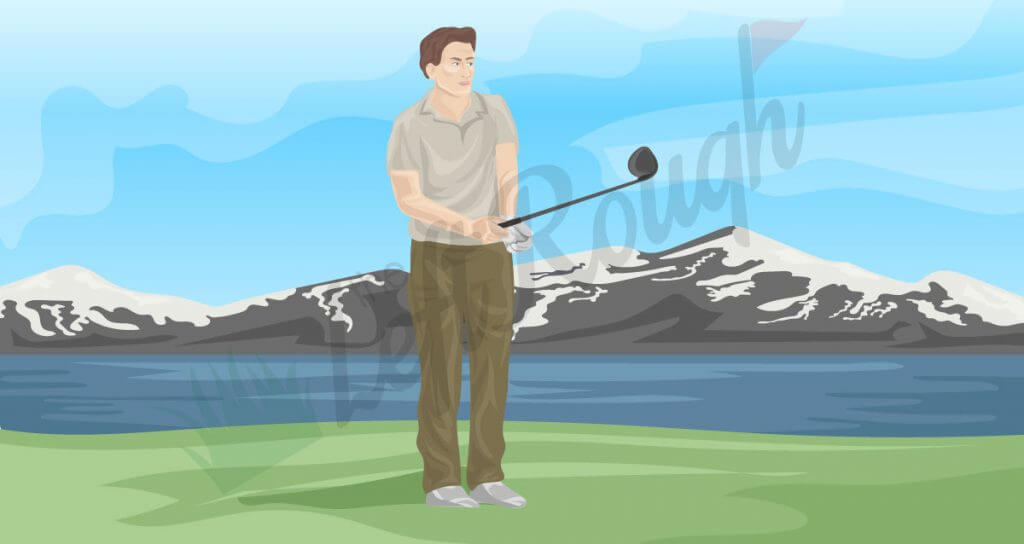
Practice Swing(s)
Now that you have chosen your club, ideal shot, and targets, it’s time to stand behind the golf ball and imagine the shot. Will you hit a draw, fade or straight ball? Where will it end up if you hit how you like? Try to imagine in detail, the more detail, the better.
Read our full article, The Art of the Practice Swing here.
As Jack Nicklaus said,
I never hit a shot, not even in practice, without having a very sharp, in-focus picture of it in my head.
Now for some players who are visually oriented, this is easy. But if you’re more kinesthetic and feel things, think about the feeling of swinging perfectly to create your ideal shot. Or, if you’re more verbal this might mean talking about the shot with a playing partner, caddy, or to yourself.
Once you have a clear image in your mind or solid feeling, it’s time for a practice swing (or two) behind the golf ball. A practice swing shouldn’t be full, massive swings but focus on having a good tempo and feeling what your ideal swing is like for your next shot.
Pro Tip: This is NOT a time to get mechanical. You should not be thinking things like “Take it more outside”, “Cock your wrists sooner”, etc.
No mechanical swing thoughts, simply positive thoughts about tempo and swing smooth. Also read our article on self-correcting bad shots mid-round.
Address the Golf Ball
Now that you have everything you need to hit the perfect shot, it’s time to execute. After feeling a few smooth practice swings, take a deep breath and start walking to the golf ball.
(Don’t overlook taking the deep breath. Breathing correctly in golf can really make a difference).
Before setting your stance, address the clubface to the intermediary target.
Then set your feet to the clubface to ensure you’re properly aligned to the target. Take a look at the target, then look back to the ball. You can do this more than once if you would like but don’t recommend more than twice as it’ll slow down your pre-shot routine.
It’s also a good idea to take a waggle as well. Then, it’s time to execute and hit the shot.
Do not stand over the ball as this will allow your mind to wander and tension set in. For 99% of amateur golfers, this will create doubt, worry, fear, and a myriad of other negative emotions. Instead, look at the target a few times and then pull the trigger!
Studies have found that a good pre-shot routine is eight seconds or less from the time you’re in your stance to hitting the golf ball. This timing does not include practice swings which should happen behind the ball, not next to it.

Create a Post Shot Routine to Accept the Outcome
Once you’ve hit the shot, your routine isn’t quite over yet.
Whether you hit it stiff to the flag or leave yourself a tough bunker shot, you need to accept it. Dwelling on bad shots only leads to more bad shots so accept the outcome.
I’d suggest having a trigger such as undoing the Velcro from your glove or putting the club back in the bag. Once this happens it’s time to forget about the last shot and prepare for the following one.
Remember, not every shot is going to be perfect because let’s get real, it’s golf! At this point laugh off bad shots and be proud of good ones… but don’t feel like you need to think about golf the entire time.
If you try to think about golf for 4-6 hours straight, you will end up worn down and mentally exhausted. Instead, enjoy the scenery, talk to other players, and enjoy being outside to relax your brain between shots.
Short-Game Routine
Hopefully, you have a clear understanding now of crafting a solid pre-shot routine for your full shots. But don’t forget that roughly 60% of your swings happen from 50 yards and in.
This is why it’s crucial to have a short-game pre-shot routine as well. Not much changes for your chipping, pitching, and putting pre-shot routines either.
With chipping and pitching, make sure you commit to a target of where you want the ball to land. You also want to think about where is the best place to leave your chip so you have an easy putt.
With putting, this is more of a personal approach but starts with reading greens.
Some players read greens from both sides, use a Plumb Bob method, use Aimpoint, or a more traditional approach. No one method is better than the other, simply find what works for you.
Once you read the greens, make sure to:
- Decide if you want a practice stroke (not all players use one like Cam Smith).
- Focus on a target – whether it’s something in front of the ball, the apex, or a part of the cup.
- Spend less than 8 seconds standing over the ball.
- Look and shoot to not overthink it.

Practicing Your Pre-Shot Routine
The last thing I want to mention is that you need to practice your pre-shot routine before you get to the course. On the range or practice area, make sure you are honing your pre-shot routine so it becomes automatic during the round.
Not to mention, it will help you commit to picking targets on the range and probably have a much better range session. The same goes for your short game practice. Train it on the practice area so you can trust it and play more consistently on the course.
If you’re in the offseason invest in an indoor putting green to dial in your putting routine as well.
My Experience
To play more consistently from tee to green and have more confidence over swing you need a routine.
Unfortunately, if you visit the driving range chances are you won’t see many golfers (if any) working on their routines. But if you want to feel confident – even high handicappers – you need to focus and dial in a good routine.
The more you can train it in practice, the more you can show up mentally prepared on the course. My biggest tip with a good routine is to make sure the timing is less than 8-seconds once you’re in your stance.
A shorter golf routine will help you eliminate doubt and swing freely. If you want to learn more about this concept make sure to read the book, Golf’s 8-Second Secret by Mike Bender.
Final Thoughts on a Good Pre-Shot Routine
While it might feel like a lot right now, I promise this will get easier the more you do it. A good pre-shot routine can help you build confidence and really help your game if you practice it enough.
Remember, a pre-shot routine is your wingman on the course – it will help you feel like you have Jim “Bones” Mackay or Stevie Williams by your side. Find a pre-shot routine that works for you and stick with it – even if you’re playing poorly as it can help you bounce back.
Do you have a pre-shot routine? Or a set number of practice swings?
Let us know in the comments below.


Really enjoy your articles. Thank you
Just read your tips on winter golf, I live in France, thanks for the tips.