

Are you ready to finally learn how to hit out of greenside bunkers?
If you’re like many golfers, all you want to do is hit a good bunker shot when your ball finds the sand trap. But chances are you have too many swing thoughts like:
- Swing hard.
- Keep the clubface slightly open.
- Let the leading edge do the work.
- Hit two to three inches behind the ball.
To hit this greenside shot with confidence, we need technique, the proper mindset, and a little practice. Soon, one of the most difficult shots will be significantly easier.
Whether you’re hitting a standard pitch shot, epic flop shot, playing the bump and run, chipping, hitting a low spinning wedge or even a standard greenside bunker shot, you have to start with the fundamentals.
Key Takeaways
- A greenside bunker shot is one of the most challenging shots in golf for everyday players.
- But the reason they’re difficult is because of the wrong mindset and the incorrect technique.
- Once you walk into sand shots with the right mindset and master the fundamentals for a normal shot, you’ll have more confidence than ever.
Here’s everything you will ever need to know when it comes to hitting out of greenside bunkers. If you are looking for help with fairway bunkers, click here.

Getting Over the Fear of Bunkers
What’s your biggest fear in golf? Is it…
- Missing a two-foot putt?
- Topping it off the first tee?
- Hitting out of the sand trap?
- Skulling a wedge over the green?
If you have more than one, don’t worry, you’re not alone. All golfers play two games; the one externally where people can see your shots and one inside where it’s you vs. you.
Understanding the mental side of golf is a huge part of the game. As Sam Snead said, “Of all the hazards, fear is the worst.”
And part of that mental game comes down to addressing the shots you fear. If you’re experiencing fear toward any shot, you must address it head-on. Get a lesson, read a book, watch a video…do whatever it takes to learn it.
If your fear is hitting out of the sand, let’s first address a stat that should ease some of those fears.
According to the PGA Tour, “The average PGA TOUR percentage is a shade over 50 percent.”
Yes, the best players in the world only get sand saves roughly 5 out of 10 attempts.
Similar to understanding the average greens in regulation, it’s important to know how top players perform in the sand. Knowing this stat alone should help you take the pressure off yourself.
For the majority of amateur golfers, the goal of hitting out of the sand is to get it out and give yourself a chance to make the putt. If you make bogey, don’t beat yourself up…the pros do it half the time!
Now that we’ve addressed the fear of bunkers and curbed your expectations, let’s get into the fundamentals of hitting out of greenside bunkers.
Greenside Bunker Shot 101 – Develop Your Normal Shot
Hitting great sand shots starts with a proper setup. You can’t play this like a normal chip shot as your club never even hits the ball but instead hits the sand. Here’s how you need to adjust your technique accordingly.
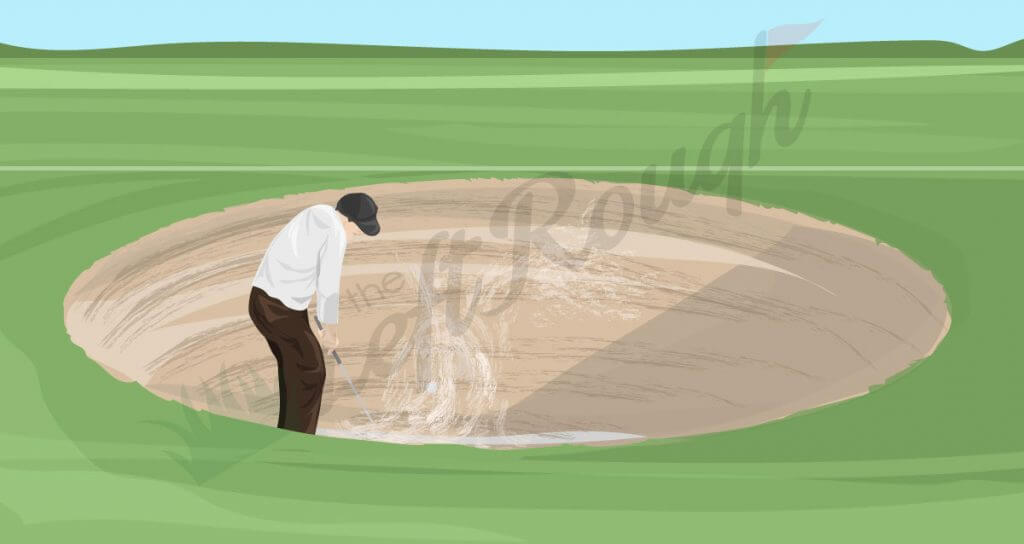
Change Your Address Position to Lower Your Hands
The first thing to do when you get into a standard greenside bunker is to adjust your posture. You need to have a little bit of extra knee bend at address.
The reason?
You want 90% of the swing to come from your arms and have very little lower body movement. Squatting down more than normal will give you a stable base to keep your lower body firmly planted in the sand.
A wider base will also make it easier to lower the handle of the club to expose the bounce of the club more and open the clubface. Remember, as Bob Vokey said, “Bounce is your friend.”
A wider stance will also help keep your feet cemented in the sand to minimize lower body movement and give your arms more freedom.
Adjust Your Weight & Open Your Stance
Have you ever checked your weight distribution at setup when you hit bunker shots?
If you’re suffering from skulling shots or hitting them thin, one reason might be your weight. If your weight isn’t more on your front foot, it’s easy to sail a few long of your target.
You want to have about 60% of your weight on your front foot.
This will make it easy to hit behind the ball with a steep angle of attack. If your weight is 50-50 or worse, 40-60, you’ll change the swing path to hit up on the shot and likely thin it over the green.
Position the Ball Front of Center
Ball position is another crucial part of greenside bunker shots. Yfou want the ball position in the front-middle of your stance.
If it’s too far up (near your front foot) it’s hard to get enough sand. If the ball is too far back in your stance (near your back foot), it’s easy to chop down on it, hit it fat, and leave it in the sand trap.

Choke Up and Lighten Up
A good rule of thumb is to choke up at least one inch on the club for a standard bunker shot. If the ball is below your feet, don’t choke up at all. The more the ball is above your feet, you should choke up 1–2 inches. This will give you more control and allow you to get the club up quickly on your backswing.
Also, check your grip pressure. So many players are so terrified of bunkers that they get tense and put a death grip on the club. This will only make things worse!
Bunker shots require a lot of finesse and feel to pull them off. You can’t do that if you’re choking the grip. Instead, try to have a 4-5 out of 10 for grip pressure. This will make it easier to cock your wrists quickly.
Open the Clubface
To hit great sand shots, you have to open the clubface to get the golf ball out of the trap. One of the biggest mistakes most golfers make on a sand shot is not opening the face… but this is a recipe for disaster.
For the most part, amateur golfers are terrified of opening the clubface in the sand. Just like the fear of opening the face to hit a flop shot, it gives so many players fear that if they open it they will hit it fat and leave in the bunker. Or they’ll hit a groove low and blade it over the green.
It’s time to dispel that myth once and for all. To hit consistently good bunker shots, you have to open the clubface, probably more than you think!
Remember, you’re not touching the ball with the club. You’re hitting the sand, which then throws the ball out of the bunker and on the green.

Just watch any PGA Tour pro on TV and you will notice their clubface is wide open at address. This allows them to consistently make great contact and hit all types of shots from bunkers.
Cock Your Wrists Quickly & Finish High
The arms are the primary muscles behind hitting out of the sand. You have to cock your wrists quickly and think of going up and down, not around your body.
Remember, the majority of bunker shots aren’t long, so you don’t need a huge swing to hit them. Keep it compact to hit crisp bunker shots.
As you accelerate through the shot, make sure you finish your swing. The goal is to keep the clubface open through impact and finish high.
Some golfers like Jason Day prefer to finish super high as if it’s a full shot. While others, like Tiger, prefer a mid-waist finish. Test them both out with a little practice to see which one produces the best shots.
Take Some Sand and Accelerate
One of the challenges with greenside bunker shots is understanding how much sand to take. Remember, you do not hit the ball, you hit the sand which is why you need to hit two to three inches behind the ball.
Another huge mistake amateur golfers make is decelerating through impact. You need to have speed and accelerate through the shot. Otherwise, you will most likely plop the sand too far behind the ball and leave it in the bunker.

How to Hit From Greenside Bunkers
Now that you have the right technique and fundamentals to hit from greenside bunkers, it’s time to pull the shot off. While the form is crucial, you also need to follow these tips before hitting out of a sand trap.
1. Assess The Lie and Shot
Like chipping and pitching, your lie plays a huge role in what type of bunker shot you can pull off. The three main types of lies are clean, buried (or plugged), and a fried egg. We’ll cover how to hit from each shot in the next section.
Once you’ve evaluated the lie, it’s time to strategize your ideal shot. Is it a short-sided shot or do you have some green to work with? Is there trouble for long if you hit it thin? What’s the best shot overall?
The more of a game plan you create for bunker shots, the more you can reduce fear when you walk into a sand trap. Keep it simple and play the shot that will give you a chance to make a putt.
2. Choose the Right Wedge
Now that you have an idea of what type of shot you’re going to play from the bunker, it’s time to determine the right weapon to use. Most golfers carry 3–4 wedges. The sand and type of shot are the two biggest factors in selecting the right club to use.
- For example, if the sand is super fluffy, you want to choose a club with high bounce to glide through the sand.
- If the sand is firm, you want one with less bounce.
- If you have a 20-30 yard bunker shot, a gap or pitching wedge might be the best way to go.
- A longer bunker shot means you will keep the club face more square and require a longer swing. Doing it with a lob wedge might require you to feel like too big of a swing, which is why a lot of players prefer a sand wedge for this type of shot.

3. Stick to a Routine
Another important part of hitting it out of bunkers is having a consistent pre-shot routine. While it can differ (and probably should differ) from your full swing, it’s vital to have a go-to routine. This will allow you to take away pressure, not overthink the shot and pull the trigger.
With any good pre-shot routine, don’t forget to visualize and see where the ball lands and where it ends up. Many golfers neglect a routine, which is one of the reasons they list bunkers as one of the hardest shots in golf.
Golfers are constantly thinking things like “Don’t leave it in the bunker” or “Don’t skull it long.” If you’re doing this, it is setting yourself up for failure!
Like any shot, it’s crucial to know where your target is.
You have to focus on what you want, not what you don’t want to happen.
Try to find a specific target that you can focus on. Whether it’s just over the fringe, a dark spot on the green or an imaginary window you want the ball going through above the lip. This will give your mind something to focus on and hopefully hold away the negative thoughts in the process.
4. Commit to the Shot
Once you’re ready to pull the trigger, take a breath and go. Commit 100% to the shot you want to hit.
Once you’ve hit it, accept the results and move on. If you leave in the sand (it happens to the best of us), regroup, and do it again. Keep breathing and don’t let your temper get the best of you.

Hitting Different Sand Shots
Another part of hitting sand shots out of greenside bunkers is learning how to hit out of different types of sand and different conditions. For example, if you live in Florida, the sand is much different than the sand in the other parts of the world.
Knowing how to hit out of different types of sand is a great way to adapt to new conditions and give yourself the best chance to get it up and down. One thing to do is evaluate the sand when you get into the bunker.
See if you can feel how much your feet will dig in (or not) into the sand. This way you can see if it’s fluffy or firm and make sure to hit sand shots before the round during your warm-up routine if possible.
How to Hit From Fluffy Sand
Fluffy sand wrecks havoc for many golfers. To hit it well, you have to open the club face a lot and swing harder than normal to get through all that extra sand.
Bounce plays a bigger role when you’re hitting from fluffy sand. Make sure that you choose the wedge that has the most bounce. This will allow it to go through the extra sand easily.
How to Hit From Wet Sand
Wet sand tends to happen when you play early in the morning and if you’re playing winter golf. You don’t need to change the swing path, but instead, don’t open the club as much – hit it with a more square face like a standard chip shot.
You’ll also want to hit it 1–2 inches behind the ball instead of 2-3. Don’t forget to accelerate as sand is always heavy and wet sand is even heavier.
How to Hit From Firm (Rock Hard) Sand
Rock hard sand is one of the most difficult shots for most golfers. If you find yourself in a bunker that feels like you’re hitting off of pavement, don’t try to do too much from the lie.
For this type of shot, you don’t want the bounce exposed, so don’t open the clubface much, if at all. Instead, opt for your lowest bounce sand wedge.
Play the ball in the middle of your stance and don’t expect the ball to get too high as you can’t open the face much. Try to take a more square to square swing instead of cutting across it like a normal bunker shot.
Lastly, keep your weight evenly distributed (50/50). If you put too much on your front foot, it’s easy to bounce the wedge off the sand. Since you’re not getting much sand on hard or rocky lies, try to nip it right behind the ball.

How to Hit a Plugged Bunker Shot
A plugged lie happens when you hit a high shot and the sand is super soft. If you find yourself in this situation, first take a deep breath, as getting mad and upset won’t make the shot any easier.
Next, evaluate the shot and where you are located to the pin. With a plugged lie, you’re not going to be able to spin the ball at all, since it’s buried.
This means you need to anticipate a ton of forward spin.
Remember, even pros in the best lies get it up and down about 50% so don’t try to do too much with this lie. Get more of your weight on your front foot and hit down on the ball with a more square face. You should get more sand than normal and not have much of a follow through.
Read our full article on the plugged bunker shot.
How to Hit a Fried Egg Bunker Shot
Equally frustrating as the buried lie is the dreaded fried egg. If this sand is pretty soft and fluffy, it’s actually easier than the buried lie.
Don’t do much different than normal except for two small adjustments.
- Get a little more weight on your front foot to steepen your attack angle
- Hit behind the ball a full 2–3 inches.
- This shot will also roll out, so plan accordingly with your landing area.

How to Hit a 30-60 Yard Bunker Shot
In Tiger Woods’ book, “How I Play Golf,” he said the 30-60 yard bunker shot is the hardest in the game. It’s hard because it’s in between how to play a greenside bunker shot and not long enough to hit like a fairway bunker shot.
Here’s how you can do it:
- Set up slightly open to the target.
- Keep a sand or gap wedge square at address. If it’s a longer shot, go with a pitching wedge or 9-iron.
- Swing like a normal bunker shot and hit one inch behind the ball.
- Keep your head still and maintain a smooth tempo. Make sure to accelerate through the golf ball to a complete finish position.
For more, check out our article on hitting a long bunker shot.

My Experience
I’ve struggled from sand traps as much as anybody. A few golf bunker shots have ruined my rounds and sabotaged success in tournaments, but I’ve found it’s a 3-part fix.
It’s a combination of having the right technique, the right mindset/routine and expectation management. Don’t forget, the average PGA Tour player gets a sand shot up and down 50% of the time. Despite what you might see on TV when the club face slides under the sand and the ball splashes out to tap in distance.
Keep that in mind the next time you’re in a greenside bunker to manage your expectations. Make it a goal to get out of sand traps in one shot, even if it’s 15–20 feet.
Final Thoughts: Get Out and Practice Your Bunker Game
Hopefully you have a plan of action for one of the hardest shots in golf.
I’ve talked about the fear of bunkers a lot in this article, and one way to end your fear of the sand is to start practicing more regularly. Even if it’s a few minutes after work, get in there and put this stuff to use. Here are 10 short game drills for your bunker game and other short game shots. You can’t just know this stuff, you have to train it on the practice area.
Once you get the standard shot down, try out different lies and practice the impossible shot as well. Remember, the harder you make it in practice, the easier it’ll be when you’re playing. Try out different wedges, different length shots, and different lies.
The more you’re in the bunker, the more comfortable you will feel when you’re playing. Find your go-to shoot so you can walk into the bunker with confidence and give yourself the best chance to get it up and down.



Nice article. I am 64 years old and need help how to keep my club face open from back to forward (the entire swing);
Thank you very much for the concise and crisp explanations. You manage to summarize Soooo much of the YouTube golf information that becomes a blur. I used to keep my own notes to try to synthesize all those tips; but now I have your site instead! Well Done!
Ron K.
Very well written by sn obvious expert in bunker play
Perfect info and all in one article!! Thank you!