Golf is not a sport for someone who wants to start something easy. It’s a wildly complex game as you need to learn how to hit 14 clubs, play on different courses, hit a myriad of shots, and master your mind under pressure.
Not to mention, learn to deal with uneven lies. Because unlike other sports – you will face a variety of shots on the course and weather conditions can also make it more challenging.
If you want to improve your game fast, you have to learn how to hit it from all types of different lies. At almost any course you will have lies that are going to challenge your game and it’s crucial to learn how to adjust.
While it’s not always easy to practice these shots, as ranges are flat, it’s important to know how to do it. Here’s what you need to know about every uneven lie so you can learn how to hit them flush.
How to Play from Uneven Lies
Key Takeaways
- Uneven lies are part of golf and require you to make changes to your swing, ball position, and body to make solid contact for proper balance.
- There are four different types of lies you need to account for in golf; these include sidehill (ball above or ball below your feet), uphill, or downhill.
- Assessing the lie is key to making solid contact and hitting the ground correctly (and not hitting it fat or thin).
- The best way to try these shots is on the course as most practice facilities are flat.
Keep reading to learn easy tips to change your setup and master these challenging shots.
The Basics of Uneven Lies
When it comes to different lies, you’re going to have four different types – each will impact ball flight differently.
- Uphill: Makes the ball fly higher and reduces distance.
- Downhill: Makes the ball fly lower and increases distance.
- Ball below your feet: Make the ball turn more left to right (a fade for right-handed golfers).
- Ball above your feet: Makes the ball turn more right to left (a draw for right-handed golfers).
In any of these four lies, balance is the main key for hitting off uneven lies.
Each type of lie will usually make you change to a different club unlike a flat lie as the loft and clubface will change at impact. Another important thing to note before hitting your shot is to know where the trouble is so you can plan accordingly.
For example, if there’s water left and you’re on an uphill or sidehill lie with the ball above your feet, you need to aim right of the target. Here are the four types of lies you’re bound to encounter and how to hit it purely from each one of them.

Uphill Lie
Here’s a good rule of thumb to remember for uphill and downhill lies:
The ball should be closer to your higher foot and weight should favor your lower foot.
Depending on the severity of the slope, an uphill lie is usually an easier type of shot to hit from compared with the other three. The number one thing to remember with an uphill lie is to always take more club.
The incline in the slope will open the clubface so you will add loft to the club and the shot will go higher. If you hit an 8-iron normally, you’ll want to usually go up at least one club to a 7-iron.
The more slope, the more clubs you should take. Evaluating slope isn’t always easy so I recommend using a rangefinderto help with that.
Next, you want to make sure to adjust your aim as the ball tends to go left from uphill lies. This is because your hands and arms are releasing up through impact which will cause the clubface to rotate closed.
Lastly, make sure to adjust your shoulders and ball position. At address, your shoulders should match the slope of the lie (in this instance, tilt your shoulders so your right is lower than your left).
You also want the ball slightly more forward in your stance to swing with the slope. Lastly, have more weight on your rear foot to help you swing up with the slope.
Downhill Lie
Downhill lies aren’t nearly as fun as uphill lies as it’s a bit more awkward at address. The key to these shots is to take less club than normal.
With an uneven downhill lie, the slope will compress the club and actually deloft it at impact. This effectively turns an 8-iron into a 7-iron and makes it travel farther with a lower trajectory.
The next thing you want to do with a downhill lie is to shift your weight so it’s slightly more on your front leg. This will help squeeze the shot and really hit down and through it.
The ball should be closer to your higher foot and weight should favor your lower foot.
With a downhill lie, you want to aim slightly left of the target as the ball will tend to leak right. This happens because you’re extending your arms down the slope and leaving the clubface open at impact.
Lastly, try to adjust your shoulders with the downslope. By adjusting your weight to your front foot and ball position, it should naturally try to match the slope. This will help make sure you don’t hit behind the golf ball and make clean contact.
With pitch shots, this is a tough lie as the ball will fly lower and not have as much spin. You might need to land the ball on the fringe and play for more release to the hole. Follow the tips above, especially getting your shoulders adjusted to the slope, move the ball back, and make sure to plan for less backspin.
Golf Ball Below Your Feet
Next is when the ball is below your feet known as a hanging lie. Since you can’t match your shoulders with the slope like an uphill or downhill shot, the main focus is making the necessary adjustments at address. You want to make sure the club is bottoming out at the right point.
The most important thing you can do with this type of shot is to keep your knees flexed consistent throughout the entire swing. It’s so easy to come out of these shots early and lose it way right if your knees aren’t remaining flexed.
Make sure to take more clubs too as the ball will tend to fade and lose distance in the process. As the ball is below you, it’s also important to not choke up on the shaft as you’re slightly farther away than normal.
Lastly, make sure to aim left as the ball will naturally shoot a bit right. And the more the ball is below your feet, the farther right it will go. These can be extremely challenging depending on the slope so lower your expectations and don’t try anything crazy.
Golf Ball Above Your Feet
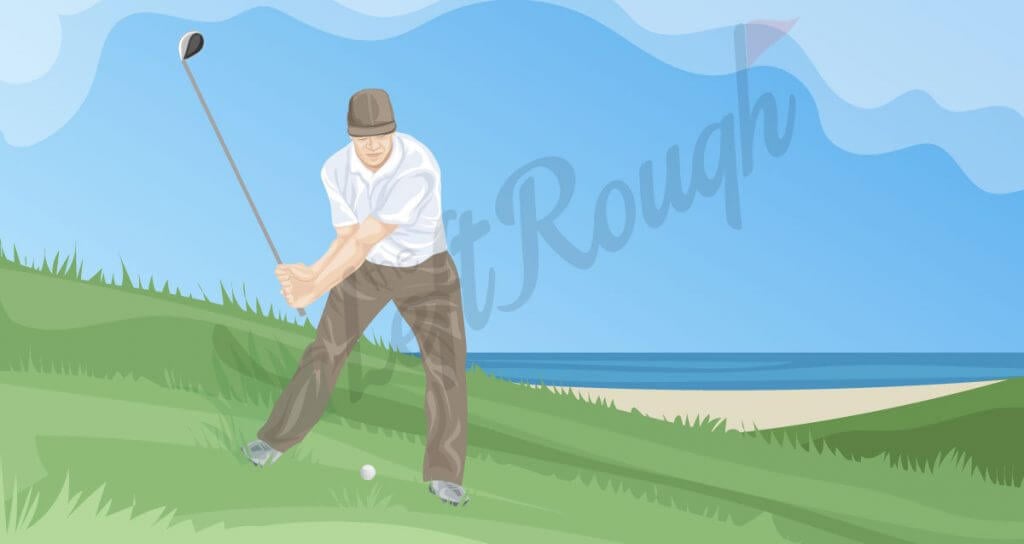
The last lie to worry about is when your ball is above your feet. This type of lie makes it easy to deloft the club and close the clubface and produce a draw or hook.
The biggest key to this lie to choke up at address. The higher the ball is than you, the more you should choke up on the golf club.
Also, you will want to take less club as the ball will draw or hook significantly depending on the distance you have to the green. The goal is to try and make a flatter, baseball type swing that is more around than steep. And if you’re in the rough, this makes it even harder.
Make sure to aim farther left as rough naturally closes the hosel at impact also making the ball shoot left.

Dealing With a Combination of Lies
Now that you know how to hit all four types of uneven lies, I’m sure you’ll find yourself getting a few of the combination lies.
For example, let’s say you find yourself on an uphill lie with the ball above your feet. Use a combination of the rules and make sure to aim far enough right, as both lies make it go left hard. The more slope, the more the club will shut and take it left.
The same goes for a downhill lie with the ball below your feet. Make sure you aim accordingly and adjust your setup at address.
Otherwise, don’t try to make too many other swing changes. Make the adjustments to the shot in your stance before you hit so that way you don’t have to manipulate your swing for each lie.
FAQs About Uneven Lies
Do you have more questions about hitting from an uphill, sidehill, or downhill lie? If so, keep reading through the most frequently asked questions and answers now.
What is an uneven lie in golf?
An uneven lie is when the ball is slightly above or below your feet. Or, it might be if your ball is on the up slope or down slope (or a mix of both). Uneven lies might require you to take more or less club, alter your ball position, and force you to hit a different golf shot.
For example, if the ball is well above your feet, you’ll need to anticipate a draw as the clubface angle will close more at impact. This will require you to aim further right of your target to
How do you deal with different lies in golf?
The first step is to assess the lie and understand if it’s above or below your feet. Then consider the slope of the shot (flat, uphill lie, or downhill lie). Each lie will impact the ball slightly differently and might force you to change clubs and targets.
Once you assess how the ball is sitting on the ground, you’ll need to factor in the new distance. For example, if the ball is on an uphill lie, you will need to take a longer club (maybe an 8-iron instead of a 9-iron) as the slope of the ground will add loft to the club. This makes the ball flight higher and affects the total distance.
Then, stick with your pre-shot routine like normal to give yourself the best chance to swing with confidence.

How do you practice uneven lies at the range?
Unfortunately, ranges are flat and not on a hill, which makes it hard to practice these shots at the range. The best way to pull off these shots is to practice during the course when you’re out during a casual round or playing solo.
My Experience
To make solid contact from uneven lies, you must first understand how the ball will react from each lie. Hopefully, you now understand how the clubface angle will change from each of the common lies at this point in the article.
Knowing how to hit each type of golf shot is step one. The second step is to practice these shots on the golf course.
Uneven lies wouldn’t be as bad if golfers could just practice them on occasion, but every range is a flat, fairway type setting (especially when hitting from mats). This makes practicing them nearly impossible. I recommend trying to practice on the course, not during peak hours or when you’re playing solo. This can help you try out a different ball position, learn the ball flight, and see how a longer club reacts differently.
Another way to practice uneven lies is to use the sides of the driving range if possible. Oftentimes, the sides of the range (or front/back) can help simulate different lies. While some clubs might not like it very much, it can help you imitate different uneven lies including rough.
Final Thoughts
If you want to take your game to the next level you need to learn these tips to adjust your shots for uneven lies. There’s no need to overcomplicate things by adjusting your swing too much. Instead, focus on identifying the type of lie and what the ball is likely to do.
Then you can take the necessary club, choke up, keep your knees flexed or whatever else to hit it pure. Changing your address position and choosing the right club is key. Don’t try to manipulate your swing or do too much with an extremely uneven lie. The goal is to try and create a feeling of a flat lie.
Always play away from trouble and try to practice these shots whenever you can. I hope these tips will help you hit it flush from uneven lies and make you look like a pro next time you’re out on the course. Semi-related, if you have traveled to a new course in a different geographic region from where you normally live, make sure you understand how elevation and altitude affect golf distance.
Next, make sure to read these guides about other challenging shots in golf: